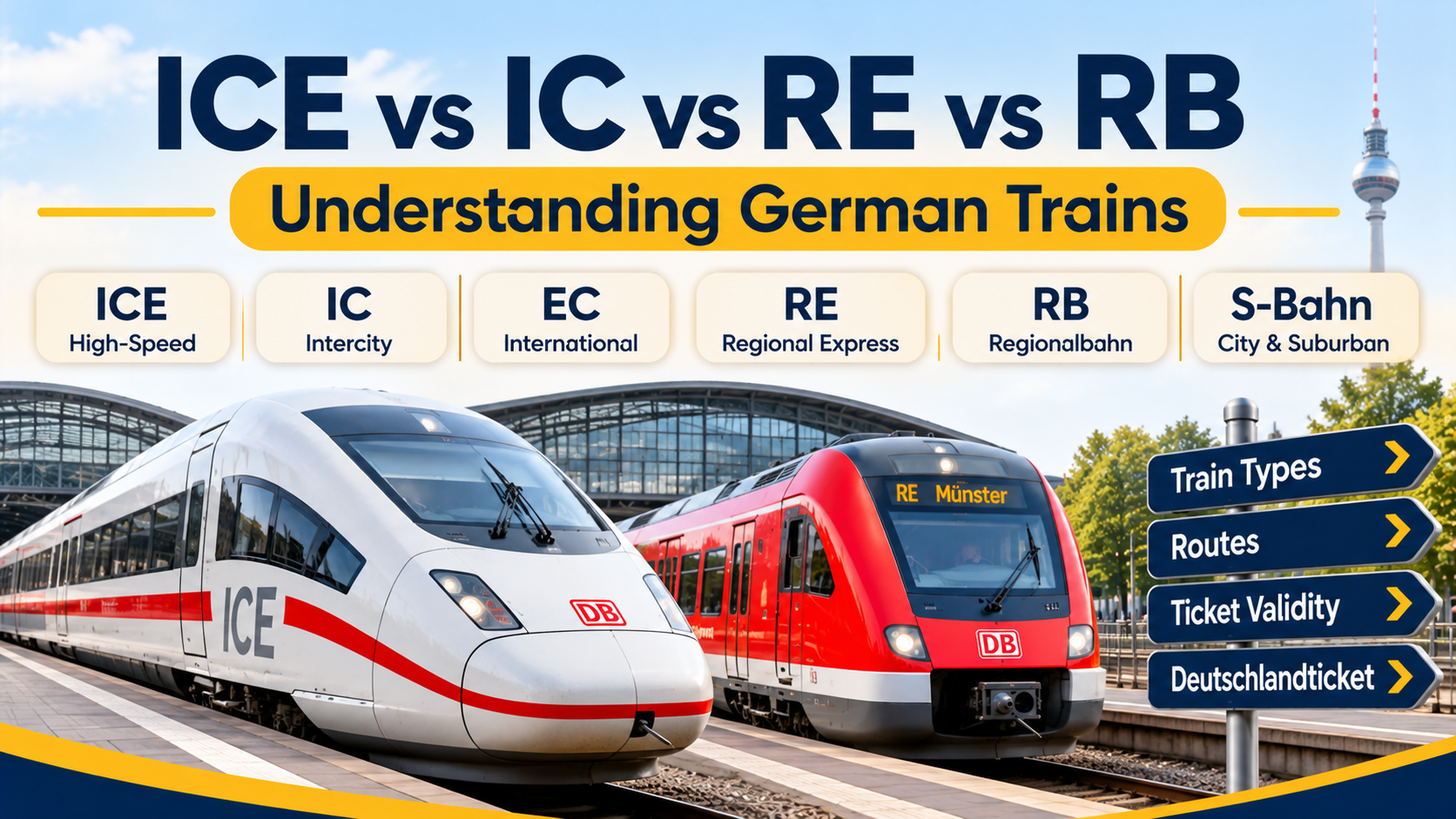
ICE vs IC vs RE vs RB: Understanding Different Trains in Germany
Introduction
If you are planning to study in Germany, travelling by train will probably become part of your everyday routine. You may need to travel between cities for university, visit friends, attend appointments, or explore different parts of the country.
However, when you check a train timetable or the DB Navigator app, you will notice abbreviations such as ICE, IC, EC, RE and RB. These letters represent different categories of trains, and choosing the wrong one can affect your journey time, ticket validity and travel cost.
Understanding the difference between these train types will help you plan your journeys more confidently.
1. ICE – Intercity-Express
ICE stands for Intercity-Express. It is Deutsche Bahn's high-speed long-distance train category and connects major German cities as well as selected international destinations.
ICE trains are generally suitable when you want to travel longer distances quickly.
Key features:
- Connects major cities such as Berlin, Munich, Frankfurt, Hamburg and Cologne.
- Runs on high-speed routes where available.
- Usually offers comfortable seating, luggage storage and onboard facilities.
- Some services provide Wi-Fi and an onboard restaurant or bistro.
- Usually costs more than regional train options, depending on the route and booking time.
When should you choose ICE?
Choose an ICE when you need to travel between distant cities and want to reduce your journey time. For example, if you are travelling from Frankfurt to Munich, an ICE connection may be a convenient option.
2. IC – Intercity
IC stands for Intercity. These are long-distance trains that connect major cities and regional destinations across Germany.
Compared with ICE services, IC trains may stop at more stations and can take longer on certain routes. However, they can be a practical alternative when an ICE connection is unavailable or more expensive.
Key features:
- Connects cities and selected regional destinations.
- Usually operates at conventional long-distance speeds.
- May stop at smaller cities that are not served by every ICE connection.
- Offers seating and luggage facilities.
- Ticket prices depend on the route, fare type and booking conditions.
When should you choose IC?
Consider an IC when it offers a convenient direct connection or a lower fare than the available ICE options. Always compare the total journey time before booking.
3. EC – EuroCity
EC stands for EuroCity. It is a long-distance train category used for international connections between Germany and other European countries.
These services are operated in cooperation with railway companies from different countries.
Key features:
- Connects German cities with destinations in neighbouring European countries.
- Useful for cross-border journeys.
- May include coaches operated by partner railway companies.
- Travel conditions and onboard facilities can vary depending on the service.
When should you choose EC?
Choose an EC when you are planning an international train journey, such as travelling from Germany to Austria, Switzerland or another connected European destination.
4. RE – Regional-Express
RE stands for Regional-Express. It is a regional train service that connects cities and towns within a region.
RE trains generally stop at selected stations rather than every station on the route. They are useful for travelling between nearby cities and connecting with long-distance trains.
Key features:
- Connects cities and towns within a region.
- Usually makes fewer stops than an RB service.
- Useful for daily travel, university commutes and regional trips.
- Often accepts regional transport tickets and the Deutschlandticket, subject to the applicable conditions.
- Seat reservations are generally not required.
When should you choose RE?
Choose an RE when you are travelling between nearby cities or commuting to your university from a surrounding town. It can be a practical option for students who want to manage their regular travel expenses.
5. RB – Regionalbahn
RB stands for Regionalbahn. It is a local and regional train service that connects smaller towns, villages and cities.
Unlike many RE services, RB trains generally stop at more stations along their routes.
Key features:
- Connects smaller towns and regional communities.
- Usually makes more frequent stops than RE trains.
- Useful for short-distance journeys.
- Often accepts regional transport tickets and the Deutschlandticket, subject to the applicable conditions.
- Generally does not require a seat reservation.
When should you choose RB?
Choose an RB when your destination is a smaller town or a station that is not served by an RE or long-distance train. It is also useful for reaching connecting stations.
6. S-Bahn – Suburban and City Rail
You may also come across the term S-Bahn when travelling within German cities.
S-Bahn services operate frequent connections within urban areas and between city centres and surrounding communities.
Key features:
- Suitable for everyday city and suburban travel.
- Connects residential areas, city centres and important transport hubs.
- Usually has frequent departures.
- Often connects with buses, trams, U-Bahn and regional trains.
- The Deutschlandticket is generally valid on S-Bahn services.
When should you choose S-Bahn?
Use the S-Bahn for regular city travel, such as commuting from your accommodation to university or travelling to a nearby suburb.
7. Quick Comparison: Which Train Should You Choose?
- ICE: Best for fast, long-distance travel between major cities.
- IC: Useful for long-distance journeys with connections to additional cities and towns.
- EC: Suitable for international train journeys across European countries.
- RE: A practical option for regional travel with selected stops.
- RB: Useful for reaching smaller towns and stations.
- S-Bahn: Best for regular city and suburban travel.
Remember that the fastest train is not always the most economical option. Compare departure times, transfers, ticket prices and total journey duration before choosing.
8. Does the Deutschlandticket Work on Every Train?
No. This is one of the most important things international students should understand.
The Deutschlandticket is designed for local and regional public transport. It is generally valid on:
- RE – Regional-Express
- RB – Regionalbahn
- S-Bahn – Suburban rail
- Eligible local buses, trams and U-Bahn services
It is generally not valid on:
- ICE – Intercity-Express
- IC – Intercity
- EC – EuroCity
Some routes and services may have specific exceptions, so always check the ticket conditions for your journey before travelling.
If you are planning a long-distance journey, you will normally need a separate valid long-distance ticket.
9. How to Identify the Correct Train on DB Navigator
The DB Navigator app makes it easier to identify train categories and plan journeys.
Follow these steps:
- Open DB Navigator.
- Enter your departure station and destination.
- Select your travel date and preferred departure time.
- Review the available connections.
- Check the train category displayed beside each service.
- Compare journey duration, transfers and ticket prices.
- Select a suitable connection and review its ticket conditions before booking.
For example, a journey may show an ICE connection followed by an RE connection. This means you will use a long-distance train for the first part and a regional train for the remaining journey.
Always check the platform and departure information before boarding, as train details can change.
10. Common Mistakes International Students Should Avoid
1. Assuming every train accepts the Deutschlandticket
The Deutschlandticket does not generally cover ICE, IC and EC services. Check the train category before boarding.
2. Choosing a train only because it is cheaper
A cheaper connection may involve several transfers or a much longer journey. Compare the complete itinerary.
3. Confusing RE and RB
RE trains generally stop at selected stations, while RB trains usually serve more stations along the route.
4. Not checking the final destination
Some trains split during a journey or have different sections travelling to different destinations. Check the train information and carriage displays carefully.
5. Ignoring transfer times
If your journey includes a transfer, allow enough time to reach the next platform. This is especially important at unfamiliar stations.
11. Useful German Railway Terms
While travelling in Germany, you may come across these common terms:
- Abfahrt: Departure
- Ankunft: Arrival
- Gleis: Platform or track
- Verspätung: Delay
- Ausfall: Cancellation
- Umsteigen: Change trains
- Direktverbindung: Direct connection
- Fahrkarte: Ticket
- Wagen: Coach or carriage
- Sitzplatzreservierung: Seat reservation
Learning these words can make it easier to understand station announcements, departure boards and travel information.
Conclusion
Understanding the difference between ICE, IC, EC, RE, RB and S-Bahn trains can make travelling in Germany much easier for international students.
For long-distance journeys, ICE, IC and EC services are useful options. For regional travel, RE and RB trains can be more economical, while S-Bahn services are convenient for everyday city commuting.
Before travelling, always check the train category, ticket validity, departure platform and connection details. A little preparation can help you avoid unnecessary expenses and make your journeys more comfortable.
At EDULX Overseas, we help students prepare for more than just university admission. From application guidance and visa support to pre-departure preparation and post-arrival assistance, we aim to make your study-abroad journey easier at every stage.
Website: https://edulx.in
Contact: contact@edulx.in
Verified by Edulx Germany Specialists
Have questions about your profile or APS verification? Book a free 1-on-1 session with our Pune counsellors.