What Is Rundfunkbeitrag in Germany? A Complete Guide for International Students
What Is Rundfunkbeitrag in Germany? A Complete Guide for International Students
When students plan their budget for studying in Germany, they usually consider rent, groceries, transportation, health insurance, and university-related expenses. However, there is another household cost that can surprise international students after they arrive: the Rundfunkbeitrag, Germany's public broadcasting contribution.
Students may receive a letter about this payment even if they do not own a television or radio. Others may live in shared accommodation and wonder whether every person has to pay separately.
Understanding the rules before moving into your accommodation can help you avoid confusion, unnecessary duplicate payments, and missed correspondence.
In this guide, EDULX Overseas explains what the Rundfunkbeitrag is, how much it costs, how it works in shared flats and student residences, and which students may qualify for an exemption.
1. What Is Rundfunkbeitrag?
Rundfunkbeitrag is a contribution that helps fund Germany's public broadcasting services, including ARD, ZDF, and Deutschlandradio.
It supports public-service television, radio, and digital media services. The contribution is generally linked to the household rather than the number of people living there or the number of devices they own.
This means you may be required to contribute even if you do not watch television, listen to the radio, or use the public broadcasters' online services.
For international students, the important point is that being a student or a foreign national does not automatically exempt you from the contribution.
The official website provides information specifically for students, including guidance for people living alone, sharing accommodation, or staying in student residences.
Official resource: Rundfunkbeitrag — Information for Students
2. How Much Is the Rundfunkbeitrag in Germany?
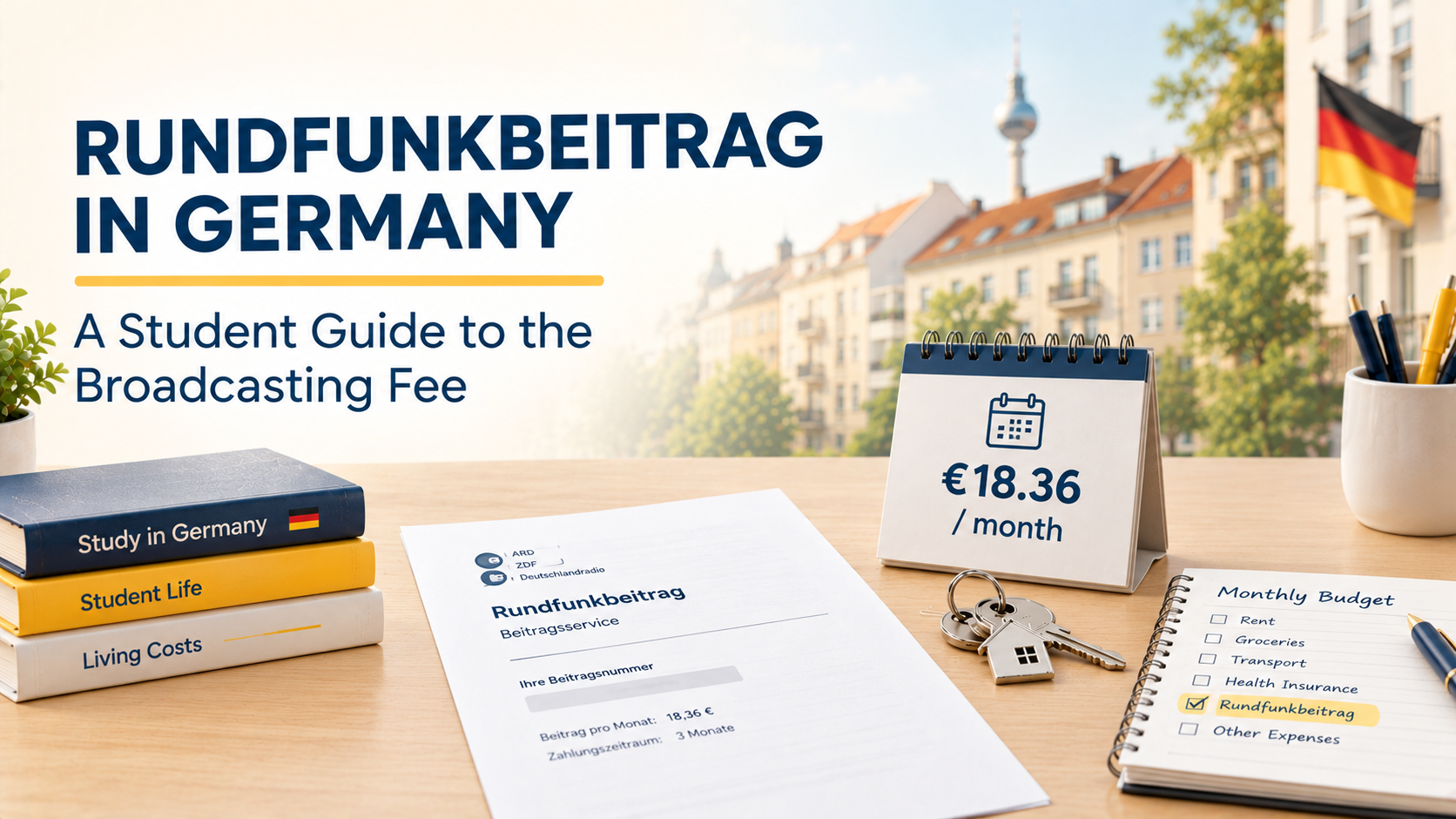
The current contribution is €18.36 per month for each chargeable dwelling.
It is generally collected in three-month periods, amounting to €55.08 for a full three-month payment period.
For students planning their monthly budgets, the amount can be considered as a recurring household expense.
For example, if you live alone and are responsible for the contribution, you should account for the full monthly amount in your budget.
If you live in a shared flat, the contribution is generally paid once for the shared dwelling, and the residents can agree how to divide the cost among themselves.
These are different situations, so it is important to establish whether your accommodation is treated as one dwelling or several separate dwellings under the applicable rules.
The amount and payment arrangements should be checked on the official website before making a payment.
Official resource: Rundfunkbeitrag — Official Website
3. Who Needs to Pay the Broadcasting Contribution?
The general rule is that a contribution is due for each chargeable private dwelling in Germany.
The number of occupants and the presence or absence of televisions, radios, or computers do not determine whether the contribution is due.
Here is how the rules commonly apply to different student accommodation arrangements.
Students living alone
If you rent and live in your own apartment, you will generally be responsible for ensuring that the dwelling's contribution is registered and paid, unless an applicable exemption or another special arrangement applies.
Students living in a shared flat (Wohngemeinschaft or WG)
In a typical shared flat, the contribution is paid once for the dwelling rather than once per student.
The residents can agree which eligible adult will register and make the payments. Other residents should provide the existing contribution number if the Beitragsservice contacts them to clarify their payment obligation.
Do not automatically open another account just because you personally receive a letter. First check whether the dwelling is already registered.
Students living with their parents
If you live with your parents in a dwelling for which the contribution is already paid, you generally do not need to pay a separate contribution for the same dwelling.
Students living in university accommodation
Student residences require particular attention because the legal classification of the accommodation matters.
A self-contained room that is separated from a communal corridor by its own entrance door may be treated as a separate dwelling for contribution purposes. By contrast, rooms within a shared apartment may be covered by one contribution.
Therefore, do not assume that all student halls follow the same arrangement. Check the rules for your specific residence.
4. What Should You Do If You Live in a WG?
Shared accommodation is common among international students because it can make living expenses more manageable.
However, residents should clarify the broadcasting contribution when they move in.
Follow these steps:
Step 1: Ask your flatmates. Find out whether someone already pays the Rundfunkbeitrag for the dwelling.
Step 2: Request the contribution number. If the accommodation is already registered, ask the paying resident for the relevant Beitragsnummer.
Step 3: Respond to official correspondence. If you receive a letter asking about your payment obligation, follow the instructions and provide the existing contribution number where appropriate.
Step 4: Agree on cost-sharing. Discuss with your flatmates how the household contribution will be divided. For example, four residents sharing the full €18.36 monthly cost equally would each contribute €4.59 per month.
Step 5: Update the arrangement when someone moves out. If the person who manages the contribution leaves the apartment, the remaining residents should ensure that the dwelling continues to be registered and paid for correctly.
Keep a record of any agreement about cost-sharing to prevent misunderstandings later.
5. Are International Students Exempt From Rundfunkbeitrag?
No. International students do not receive an automatic exemption simply because they are studying in Germany.
The contribution rules generally apply regardless of nationality or student status. However, certain individuals can apply for an exemption if they meet specific eligibility requirements.
This distinction is important for students who are relying on scholarships or financial support from their home country.
Exemption for eligible BAföG recipients
Students receiving qualifying BAföG support who do not live with their parents can generally apply for an exemption, subject to the applicable requirements.
The exemption is not automatic. An application and the required supporting evidence must be submitted.
What about international scholarships?
Receiving a scholarship does not automatically make a student exempt.
The official guidance explains that students receiving Erasmus funding or other scholarships are generally still liable for the contribution. Certain exceptional hardship situations may be considered, but these depend on the specific circumstances and applicable rules.
What if you cannot afford the contribution?
Financial difficulty alone does not guarantee an exemption.
If you believe you qualify under a recognised exemption or hardship provision, consult the official eligibility guidance and ask the Beitragsservice what supporting documents are required.
Do not assume that being unemployed, having a limited student budget, or not using public broadcasting services is sufficient.
Official resource: Rundfunkbeitrag — Students and Exemptions
6. How Do You Register for the Rundfunkbeitrag?
If you are responsible for paying the contribution and your dwelling is not already registered, you should complete the required registration process.
The general process is as follows.
Step 1: Confirm whether registration is already in place.
Before submitting a new registration, check whether another resident has already registered the dwelling.
Step 2: Visit the official website.
Use the official Beitragsservice website to find the appropriate registration service and current instructions.
Step 3: Provide accurate information.
Complete the requested details about the dwelling and the person responsible for the contribution.
Step 4: Follow the payment instructions.
Check the payment amount, due dates, and available payment methods. Keep your contribution number and payment records safely.
Step 5: Respond to future correspondence.
Read letters carefully and respond within the stated deadlines if information or action is requested.
Use the official website rather than unofficial websites that charge for completing basic registration.
7. What Should You Do If You Receive a Letter From Beitragsservice?
Receiving an official letter can be confusing, especially when it is written in German.
Do not ignore it. First, identify what the letter is asking you to do.
It may request that you register your dwelling, provide an existing contribution number, clarify your living arrangement, or settle an outstanding amount.
Read the instructions carefully and check the response deadline.
If you live in a WG and someone else already pays for the dwelling, obtain that person's contribution number and follow the letter's instructions for reporting an already registered dwelling.
If you believe you qualify for an exemption, check the required application procedure and supporting evidence.
If you have already paid the contribution, keep proof of payment and contact the official Beitragsservice if the letter appears to relate to the same period or dwelling.
If you are unsure what a letter means, seek assistance from your university's international office or a qualified adviser. Do not assume that every letter is a bill, and do not assume that every letter can be disregarded.
8. What Happens When You Move to Another Apartment?
Students often change accommodation during their studies. You might move from a student residence to a shared flat, relocate for an internship, or move to another city.
When your accommodation changes, check whether you need to update your existing contribution account or complete another registration procedure.
If you are the person registered as the payer, the contribution number is associated with you and your account. You should notify the Beitragsservice of your new address according to its official instructions.
If you move into a WG where another resident already pays for the dwelling, you should clarify your status rather than automatically opening a new account.
Similarly, if you are the registered payer and leave a shared flat, inform the remaining residents so they can arrange the ongoing payment correctly.
If you leave Germany permanently, check the official deregistration requirements and complete the appropriate process where applicable. Moving abroad does not mean you should simply stop responding to correspondence.
Official resource: Rundfunkbeitrag — Official Website and Services
9. Common Mistakes International Students Should Avoid
Understanding a few common mistakes can help you manage the contribution correctly.
Assuming students are automatically exempt: Student status alone does not provide an exemption.
Paying twice for the same shared flat: Check whether a resident already pays for the dwelling before registering.
Ignoring official letters: Read correspondence carefully and respond as instructed.
Assuming no television means no payment: The contribution generally applies regardless of whether you own or use broadcasting devices.
Confusing the contribution with rent: It is a separate household contribution and may not be included in your rent.
Assuming every student residence is treated the same: The classification of your particular accommodation can affect the payment obligation.
Assuming a scholarship guarantees an exemption: Eligibility depends on specific legal requirements, not simply the existence of financial support.
Forgetting to update your details after moving: Follow the official process when your address or household arrangement changes.
10. Rundfunkbeitrag Checklist for Students in Germany
Use this checklist when arranging your accommodation and monthly budget:
Find out whether the dwelling is already registered.
Confirm who is responsible for the contribution.
Budget for the current contribution if you are liable to pay.
If you live in a WG, obtain the existing contribution number where appropriate.
Check whether your student residence is treated as one dwelling or separate dwellings.
Review the official eligibility rules if you believe you qualify for an exemption.
Keep payment records and official correspondence.
Respond to letters within the stated deadlines.
Update your details when moving to another address.
Use the official Beitragsservice website for registration, payment, and exemption procedures.
Frequently Asked Questions
1. Is Rundfunkbeitrag compulsory for international students?
Generally, yes, if they live in a chargeable dwelling and no applicable exemption or other exception applies. International student status alone does not provide an exemption.
2. How much is Rundfunkbeitrag per month?
The current contribution is €18.36 per month for each chargeable dwelling. It is generally collected in three-month periods.
3. Do all students in a shared flat have to pay separately?
No. In a typical shared flat treated as one dwelling, the contribution is paid once. Residents can agree how to share the cost.
4. Do I have to pay if I do not own a television?
Generally, yes. The contribution is not determined by whether you own a television, radio, or other receiving device.
5. Can international students receive an exemption?
Some students may qualify under specific rules, such as eligible BAföG recipients. However, there is no automatic exemption for international students or scholarship holders. Check the official criteria before applying.
6. Is the broadcasting contribution included in student accommodation rent?
Not necessarily. Whether it is included in a particular accommodation arrangement depends on the housing contract and the applicable rules. Ask your residence administration or landlord and verify who is responsible for payment.
7. What if my flatmate already pays the contribution?
Ask for the dwelling's contribution number and follow the official instructions if you receive correspondence. Do not automatically register and pay again for the same dwelling.
8. Do I need to update my details when I move?
If you are registered as the payer, you should follow the official procedure to update your address. If you move into a dwelling already covered by another resident, clarify your payment status and follow the relevant instructions.
Final Thoughts
Understanding the Rundfunkbeitrag is a small but useful part of preparing for student life in Germany. Knowing how the contribution works can help you avoid duplicate payments, plan your monthly expenses, and respond appropriately to official letters.
Before moving into your accommodation, ask whether the contribution is already being paid and clarify your responsibilities. If you believe you qualify for an exemption, check the official criteria and apply with the required documents.
A little preparation can make everyday administration easier and help you settle into your studies with fewer surprises.
Planning to study in Germany? EDULX Overseas supports students with profile evaluation, university and course shortlisting, SOP and LOR guidance, application assistance, visa guidance, scholarships, education loans, accommodation, pre-departure preparation, and post-arrival support.
Visit edulx.in to explore how EDULX can support your study abroad journey.
Verified by Edulx Germany Specialists
Have questions about your profile or APS verification? Book a free 1-on-1 session with our Pune counsellors.